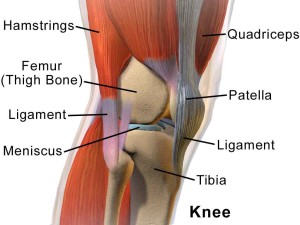
The focus of this post is on knee pain, one of the most commonly injured sites on a rower. If you’re curious about one of the ways that knee pain is caused, and better yet, how to prevent it, read on!
Factors both inside and outside the boat can cause knee pain. The three main factors are body structure, muscular imbalance, and rowing technique. Oftentimes knee pain among rowers can be attributed to cross training, especially activities like running, biking, and weight lifting.
The lower extremity kinetic chain consists of three joints: the ankle, the knee, and the hip. The knee is capable of moving in only one plane, and the foot and the hip complex influence the orientation of that plane of motion with respect to the body’s centerline. The ankle and the hip rotate in three different dimensions compared to the knee’s single plane of movement. As such, if the hip is not compensating for the biomechanical anomalies of the foot and ankle, the ankle passes these stresses on to the knee.
The first factor that can cause knee pain is a structural imbalance. For example, in a forefoot varus the bones on the inside of the forefoot sit higher than the bones on the outside of the forefoot during weight bearing movements. As you begin to put weight on the foot stretchers during the drive phase of the stroke, your leg alignment naturally adjusts in order to allow your full forefoot to make contact with the foot stretchers. To allow for the forefoot to make full contact with the foot stretcher, the knee of that leg twists inwards towards the center plane of your body. This throws off the ideal alignment of your ankle, knee, and hip and puts undue pressure on the knee.
Muscular imbalances can also cause knee-related pain among rowers. In particular, weakness in the glutes and tightness of the hip flexors can cause the upper leg to rotate inwards. This can cause the knee cap to glide laterally and grind against the outside edge of the groove where it sits. This manifests as pain on the outside of the knee or swelling of the knee. Therefore if you have imbalanced musculature in the lower body, these muscles of unequal strength adversely impact the alignment of your knee.
And the final factor that affects knee pain is technique. Structural and muscular problems like over-pronation, IT band tightness, and/or hip weakness can all noticeably impact rowing technique in a negative way. These structural problems and muscular imbalances can thus cause pain and/or injury when combined with rowing by imparting large forces on the knee in directions that are outside of the plane of movement of the knee.
Fortunately there are ways to combat these structural problems and muscular imbalances! The best preventative measures involve practicing regular stretching and strengthening exercises. You can minimize the likelihood of experiencing knee pain by focusing on stretching that affects the calves, hamstrings, glutes, IT bands, and hip flexors in addition to strengthening the hip abductors, hip rotators, and hip extensors.
An additional measure you can make is to employ the help of ergonomic aids. Over-the-counter orthotics can help reduce the negative impact of structural problems in the foot. Insoles can also be modified with athletic tape to provide more support under the foot if you experience a forefoot varus. This will help maintain the alignment of the knee with the body during the drive of the rowing stroke.
And finally, there are several adjustments you can make to your position within the boat to help reduce knee pain. We recommend working with your coach to adjust the foot stretcher position, lower the oar the height, change your angle with relationship to the pin, and/or use a seat pad. These simple adjustments, when made with the assistance of a coach, can improve your comfort within the boat while maintaining geometries at your seat that will complement the rest of your crew.
Knee pain is typically preventable, and we hope that with this information, you can get yourself closer to a more comfortable time on the water.
